Wednesday, October 9, 2013

Assassin with a heart of gold. Why not?

3.5 Stars

Here is the thing.  Sometimes I hear many people laud a book that I feel is just alright.  In the case of Sarah Maas' Throne of Glass, I was hoping to add my own applause as so many of my fellow librarians told me it was a must read.

While I can't say that this was a bad book by any means, I didn't love it either.

Celeana Sardothien is the most notorious assassin in the kingdom.  When she was caught (betrayed?) she was sentenced to hard labor in the prison of Endovier for her crimes.  Her crimes of assassinating several people.  We are told this many times.  Celeana is a well known assassin.  The assassin.  I get it.  In fact I was having a bit of "show don't tell" trouble when it came to Celeana's checkered past.  I will get back to exactly how this affected by feelings about the book.

So, yes.  Celeana was an assassin.  She was caught and thrown in a labor camp.  But now the Crown Prince Dorian has sent Captain of the guard Chaol Westfield to retrieve her.  Dorian has a proposal.  For her freedom Celeana can agree to become the King's personal assassin (or champion, because it sounds far nobler) or she can return to jail and rot.  If she chooses the former she can earn her freedom in four years time.  If she chooses the latter...she dies horribly.  The catch is that Dorian's father the King does not trust Celeana or her skills so he has set up a tournament of ruffians to determine worthiness of the title.

If this sounds a little like Hunger Games, don't worry.  The tournament is only a small part of the plot.  Someone has been killing off the would be champions in gruesome ways.  Celeana herself may be the key to uncovering the who and the why.

Now that I have covered the plot I will move on to the issues.

First issue:  We hear Celeana mention how much of a bad girl she's been.  We hear other people talk about how bad she's been.  She clearly has skills.  We see this during the tournament segments of the novel.  As far as Celeana as an assassin goes, I don't need hearsay.  What I need are details.  Names.  Instances.  Body count.  Please?  Call me morbid if you will, but I have a hard time buying Celeana as a boogieman when I don't see blood.  Sure, I heard how she killed a foreman in prison for pushing her too hard but that is entirely different.  I hear about her harsh training which began at age eight, but once again this doesn't paint the big bad wolf.  Compared to say, Katsa in the Graceling series who is also a well written heroine with a brutal past?  We can smell the blood on her hands not only when first we meet her, but even as we grow to love and respect her.  Celeana didn't do that for me.

In a way, this problem is also the strength when building Celeana's character.  She is not just a killer.  She puts forth a good front at first and she has Chaol, Dorian and her guards weary of her behavior due to her reputation alone.  However what we do see (and are not told) is how Celeana adores reading, candy and puppies.  She is indeed a warm and fuzzy type of girl who enjoys a trashy romance novel as much as a historical text.

We get a feel that she has been raised and trained in a brutal environment to be a killer.  That much is true, but the rest of the novel builds her as a person.  This works.  At first we meet her Celeana is arrogant and rough.  When we get to know her she is a full person.  Someone we can like.   Someone both Chaol and Dorian can love?  This brings me to-

Second Issue:  The totally unneeded love triangle.  I didn't read the back of the book so I didn't actually see the tag line, "Two men love her.  The whole land fears her.  Only she can save them all."  However, the love triangle was so painfully obvious from the start.  Of coarse Chaol and the Dorian were gong to fall for her.  It isn't even a spoiler for me to write this.  I won't even reveal who she chooses, but it is also very, very obvious.  I doubt this will change throughout the series, but I challege Maas to prove me wrong.

Non Issues:
I loved the character of Princess Nehemia.  A great female character who was strong intelligent and cunning.  She was a great friend to Celeana and not once did they get into a fight over a love interest.  That is refreshing.  Also, the low magic world where a mystical heritage exists but remains subtle making the setting stand out in a sea of titles with themes of overt high magic.

Sure, I liked it but I didn't tear through it with white knuckles.  I didn't stay up past my bed time to squeeze in one more chapter.

If it were, say, an anime series and not a novel I may have forgiven some of the issues.  I tend to hold YA literature to a higher standard when it comes to certain tropes.

So was Throne of Glass worth a read?  Sure.  Did it have some good qualities?  Yeah.  Was it phenomenal?  It had it's moment. So will I be reading the sequels?  When I get around to it.

Sunday, August 18, 2013

"The Whipping Boy" gets an update.


4 Stars.

Sid Fleischman's "The Whipping Boy" gets an update ala YA dystopian science fiction.

Syd (16), a poor orphan from "The Valve" was born into debt.  This is a common situation in Syd's world, in fact all of his peers have 18 year of debt on their hands at work.  And like his peers, Syd's debt was bought as an infant by a wealthy benefactor who would use him as a "proxy" for Knox (also 16), a spoiled rich boy.  While some proxies are lucky enough to have mild mannered "patrons" who get into only small amounts of trouble in their lifetimes, Knox looks for trouble.  And why wouldn't he?  Knox knows that any crime he commits would be paid for in punishment by his proxy.  While Knox and Syd have never met face to face, Knox is forced to watch "his" punishments on a screen via Syd's body.

While Syd's life has been a virtual hell due to his patron's devil may care attitude, Syd take comfort in the fact that that in two years he will be Knox free and debt free.  That is, until Knox's antics cross a line that raises the stakes too high and society discovers that Syd is not an ordinary proxy.  On the run, Syd and Knox are thrown together on a journey through a futuristic Detroit where the battle between debtors and creditors have been taken to a new level.

Class warfare.  Bored, wealthy society where its citizens dress in ridiculous fashions.   This is some well worn territory for sure.  However, "Proxy" finds a fresh voice in Syd and executes its premise admirably.  I cannot think of another novel in this genre with a character like Syd.  Not only is he non-caucasian, but he is gay and his coming out is not central to the story.  Early on we know that this is who Syd is and while it contributes to all the things that make up his persona it alone does not define him.  In fact, he is a protagonist any teen can relate to regardless of race or sexuality.

While the villains could have been fleshed out a little more I have to applaud some of the plot points.
"Proxy" throws in a few curve balls that keep the plot moving.  The ending itself while not totally unexpected was heart wrenching just the same.  I look forward to spending more time with Syd in further books in this series.

Sunday, July 21, 2013

With one foot in the closet

A solid 4 star read.

My thanks to NetGalley for my ARC.

Rafe came out to his very accepting parents at a young age. His mom even threw him a party! He was never bullied in his liberal Colorado school and he enjoyed an active social life that included his best friend Claire Olivia. Sounds ideal in a world of bullied teens and tragic stories. Rafe however, is tired of being looked at by everyone as "the gay guy" and not just Rafe who happens to be gay. So he devises a plan to transfer to an elite all boys prep school in Massachusetts and live as one of the guys. He won't tell anyone he's gay, but he won't tell anyone he's straight. Or at least that is the plan. He just wants to be accepted without the label and he insists he is not going back in the closet. Or course best laid plans don't always go accordingly, and there is no pun in that statement. Especially when Rafe develops feelings for Ben, a straight (or is he bi?) student at Nattuck. 

I will admit this book made me a bit angry when I first began to get into Rafe's story. Rafe himself is extremely self centered and his oblivious, "no big deal" attitude towards hiding a key part of who he was in order to impress some real jerks grated on me. But then, that was the point wasn't it? I got Rafe's initial motivation. He was never bullied, but everyone made assumptions about him according to the fact that he was openly gay. For instance, teachers would direct specific civil right questions towards Rafe in hopes of getting a "gay perspective". Straight guys would randomly ask him if they would be considered attractive. This is the sort of naive but well intentioned dialogue I'm sure even the best of us have tripped into when dealing with a friend who is different. For Rafe, it was distracting from who he was other than gay.

So, Rafe goes to Nattuck and claims he won't comment on his sexuality one was or the other. Except he tells the guys that Claire Olivia is his girlfriend. When asked directly, he doesn't come out to his roommate's gay best friend Tobias (who has had his share of bullying at the hands of some of Rafe's jock friends) and he certainly isn't honest with Ben when the two begin to skirt the lines between friendship and a relationship. So yeah, Rafe IS actually back in the closet and very dishonest, which makes his entire "experiment" feel like a vanity project at times.

I felt so embarrassed for Ben, who was just figuring our where he stood on attraction. He really felt that Rafe was experiencing the same thing with him at the same time, and it made me very angry at the protagonist. Rafe didn't lie to Ben in order to seduce him, but Ben was missing the entirety of Rafe's story...while Ben himself was sweetly candid at all times. Also, Rafe didn't bully anyone persee, but there was at least one time when I felt like he was a bystander. Of course as time goes on, this all changes.

The thing is, Rafe is called out for his selfishness. Claire Olivia sees it. His parents see it. Rafe himself eventually realizes that his dishonesty not only hurt the people he loved but himself. I liked that, because I wanted to reach through the pages and hit him myself at a few points. 

Openly Straight cracks the door open for a bunch of questions that are not often brought up in everyday dialog let alone a YA novel. What is attraction? Can you fall in love with a person without the stigma of sexuality? Why are western guys so uncomfortable around other guys while other cultures past and present celebrated close masculine relationships. In fact, I really wish the book went a little more into the idea of omni/pan sexuality as there is a need to understand that you don't always find yourself attracted to who you think. I was impressed that the idea of male bisexuality was brought up at all. I can't say that I recall any book which touches upon that idea.

Most importantly, Openly Straight discusses love. Not just love in a relationship, but love between friends and family. Early on in the book I had to skip to the end in order to decide if I could handle all the anger I was feeling towards Rafe's behavior. What I read was honest and well thought out. Like in "If you could be mine" another LGBT themed book I had reviewed, there were no easy answers, but I expect they were honest. And in the end that is the lesson Rafe learned for his heartbreak. Be who you are. Be honest about it. If you can accept that person and you have the support of those you love, you are already well on your way

The Dirk Lloyd strikes again!

3.5 Stars

While I was amused but not blown away by the first book, I noticed the sequel to Jamie Thompson (cough) I mean DIRK LLOYD's junior novel, "Dark Lord, The Early Years" was available on Net Galley. I decided it could be a fun light read for my upcoming trip to Scotland. 

I was still not blown away by the book, but I don't think that is the point in this series. In fact I would have to say, this book hit it's stride with me where the first one missed the dance. 

The book recaps briefly what we learned in the first. The Dark Lord (think Sauron or Voldemort) or the Darklands was stripped of his powers and send to our world in the body of a twelve year old human boy. Still with some (very weakened) powers in tact, the Dark Lord was renamed "Dirk Lloyd" and sent to live as a foster son with the Purejoie family who were thought the best fit for an emotionally disturbed and delusional child. 

The story picks up where the last one left off. Sooz, Dirk's goth friend (NOT girlfriend!) was sent back to the Darklands in Dirk's place when the ritual to send him home was meant to transport only the one who wore the ring of power. Dirk had given it to Sooz in the first book only to have her make a copy to give to Dirk when he wanted it back. With the ring on her hand Sooz is confused to be Dirk's betrothed. Her gentle but dark personality charms the Dark Lord's minions. This is including Gargon, Dirk's most loyal creature, the head of the goblins and even Rufino who is a Paladin under the rule of Hasburdan (think Gandalf). 

You see, while Sooz insists on repainting Dirk's Iron tower black (Hasburdan had it painted pink in the Dark Lord's exile) she also introduces a five day work week and other amenities of our developed world that the evil Dark Lord would have never approved. Sadly for Sooz, Hasburdan still considers her evil and pledges to attack. 

Meanwhile, in our world, Dirk and his foster brother Christopher desperately try to find the means to contact Sooz and bring her home. There is some real hilarity that comes from this venture and it is different from the humor in the first book. In fact there are quite a few things that worked in this book that were absent in the first. 

While the first had a fun "Diary of a Wimpy Kid" written by Sauron thing going for it, I found myself at a real distance from the characters. Sure, Sooz was kind of sweet, but I didn't really give two figs about Chris or even the protagonist, Dirk. The unlikable hero niche that made Greg Heffley's antics so popular didn't really click for me in Dirk's case because he is more aware of his bad qualities than Greg. 

This book managed to actually make me care about Dirk, which surprised me. It also broke from the diary format which was a good breather and added some moderate depth to Dirk's motivation. Chris was still a little stiff, but I felt a definite shift in the way I felt about him. 

With a few laugh out loud moments throughout, I can say for sure that I hope the Dark Lord will reign for another volume or two.

Mwa hahahahaha!!!!!!!

Sunday, May 5, 2013

If you could only see the way she loves me, maybe you'd understand-


3.5 Stars  
A big thanks to NetGalley and Algonquin publishing house for the ARC version.

Now for the nitty gritty.
While I hoped that this would be a story of defiance in the name of true love, what I got was a more complacent look at the status of the gay community in Iran.  This does not mean that this was a bad story by any means.  In fact, I learned about the status of transsexuals in Iran which gave me a serious, "wrinkle in the brain" moment.

Let's get down to plot.  Sahar is a lesbian.  Living close by, her childhood friend Nasrin has also been her secret girlfriend for years.  Nasrin claimed Sahar as "hers" years ago when they were children and this bloomed into a deep love with the manic feelings of teenage lust and passion.  Nasrin, however is quick to declare to Sahar that they are not "gay" they are in "love" and while this may be the (pansexual) case for Nasrin, it is not for Sahar.  However, gay or not, what Nasrin says is true.  The two girls are indeed in love. 

There are some issues with their relationship, of course.  First, Sahar, while a valued friend of Nasrin's, is from a working class family while Nasrin is upper class.  More than that, the two girls live in Tehran, Iran, where a lesbian couple could be potentially killed.  Also, Nasrin seems more than a little selfish.  She is spoiled and has her whole family in tact, while Sahar has to care for her despondent father who has not been the same since the death of Sahar's mother.   While it is well known that Sahar is very smart and will most likely go to medical school, Nasrin is thought to be only good enough to marry rich.  And while Sahar dreams of herself being the successful doctor who will marry Nasrin, in reality Nasrin's family has arranged a marriage with a currently practicing (male) MD intern.  Blindsided by the engagement, Sahar is equally enraged and depressed.

The story takes a detour when Sahar's gay cousin, Ali introduces her to the gay underground in Tehran in hopes of showing Sahar that there are other eligible young women to fill the void that will be left by Nasrin.  What Sahar learns is that in Iran, a transsexual can receive a sex change operation at the partial expense of the government.  This is where that "wrinkle in the brain" came in for myself.  I looked it up and it is true.  "Gender reassignment" is considered a "cure" for a sickness in Iran.  If it is deemed that you actually are a man trapped in a woman's body or vice versa, not only is it sanctioned but the government will pay up to half the cost of the operation.  Iran is actually one of the countries with the highest number of gender reassignments preformed aside from Thailand.  However, as a homosexual, you are condemned.  

So, when Sahar meets a lovely woman named Praveen and discovers that she was once a he, love begins to take Sahar's mind to strange places.  If she was a man, she could marry Nasrin.  At least this is what Sahar believes, not taking into account how Nasrin's ultra showy family would feel about their daughter's childhood friend changing genders and marrying their princess.  Praveen agrees to introduce Sahar to a support group of transsexual youth but it becomes clear to everyone that Sahar is a lesbian and not trapped the the wrong body.  Sahar looks at the days ticking closer towards Nasrin's wedding and tries to speed up her "operation" in spite of herself.  It is a dreadful plan and everyone, including Sahar knows this.  However, it is all she has to get her through the day, especially when Nasrin frequently tells her that her heart belongs with Sahar.  

So that is the plot and background.  Without giving anything away, the story has a very open ending.  If you are expecting the girls to run away together or for the families to suddenly agree to call off the wedding and hide Sahar and Nasrin's love from the government, you will be sorely disappointed.  Again, this does not mean that this is a bad book.  I really feel that this is unfortunately a very real portrayal of how this situation could (safely) play out for these two.  Nasrin, we see is very used to creature comforts and would probably never give them up no matter how much she loves Sahar.  It also adds dimension to the story that Nasrin's fiance is actually a nice guy.  While it would have been easy for the author to create a monster akin to poor Maryam's husband in "A Thousand Splendid Suns", or so many other books that deal with arranged marriage, this author gives us a fine young man who is silly infatuated with Nasrin.  He is also eager to gain the approval of her best friend, Sahar.  Through no fault of his own, he is doomed to be hated.

Other great angles that adds some depth are the emerging friendship between Sahar and Praveen, Ali's rise and fall as the "go to guy" in the underground community and Sahar's love for her clinically depressed father.  Faced with many difficult choices, Sahar has more on her plate than other young lesbians in progressive countries and we want her to make the best ones, but because of her native country there are no easy answers.  This may make this read feel unsatisfying for some.  Still, that doesn't mean that it is not worth reading.  

Tuesday, April 16, 2013

Dreams and Shadows A review of an adult book

3 stars 

So, I picked up "Dreams and Shadows" after the book's marketing campaign finally wormed its way into my brain. Whenever I looked up a book I enjoyed or wanted to read, there was an ad for "Dreams and Shadows". 

As a children's librarian, the majority of what I read is, well, children's novels. This is not to say they are juvenile, most are quite sophisticated. Sometimes even more sophisticated than adult novels. And that is because children, tweens, teens, young adults, whatever you may call them are not stupid. I think it was Dr. Seuss who said ,"Children can smell a moral a mile a way." If that is not a direct quote, it is close. So while people get all high and mighty with me when I read children's books and say that it would drive them mad, because they are juvenile, I argue back that most of the time a good children's author will write a better story than an adult author. Because, while a child may not be totally jaded, they are not stupid. 

What does this have to do with "Dreams and Shadows"? I have been reading some adult literature lately for a number of reasons. One, I am running a 20-30 something book club at work and two, I feel like I need to be familiar with some of the more modern stuff. As I enjoy most of Neil Gaiman's writing, this one was suggested. And in a way I see how. Cargill weaves a dark fairy tale complete with some great research of fae and dark legends. Not all that "glitters" is gold in the world of fairies and djinn. Anyone who does a little probing of this type of lore realizes that cutesy victorian fairies are not very good representatives of the creatures of legend.

The main issue I had with this book was not the storytelling. I found that I wanted to know what happened next. There were points when I couldn't put it down. It was mainly the characters. 

I realize now, that I have gone through most of this review without talking about plot. Here, there are several plots running. The first is the doomed romance of Jared and Tiffany Thatcher, which begins as a story of a too perfect couple with all the luck. Their text book courtship is interrupted when they are chosen as targets of baby snatching fae who replace their newborn son, Ewan, with Knocks, a hideous changeling. This drives Tiffany to suicide and Jared to a watery death at the hands of other dark forces. Knocks is the only survivor, and while he proves a good villain, he is probably the only well fleshed out character in the entire novel. 

The second main plot is that of Colby Stevens, a little boy chosen by the cursed djinn Yashar to be "granted" a wish. When Colby's wish leads him into the dark realm of Austin Texas' fae Limestone Kingdom (yes, Austin Texas) he meets Ewan, grown into a boy around Colby's own age. While Ewan has grown into a precocious little boy seemingly beloved by the fae (especially Mallaigh or Molly, a young Sidhe) Knocks, Ewan's changeling counterpart seethes at Ewan's very existence. 

Everything comes together when ghosts or demons from the past come together and Colby discovers that Ewan's fostering by the fae has been part of a sinister plan. Colby, being a young boy who knows no better uses his bond with Yashar to give himself the power to save Ewan. Of course this is also not for the best.

The story follows these characters, Colby, Ewan, Knocks into their adult hood and while it was a fun ride, once again, only Knocks' rage fully fleshes out his character. I would have liked to get to know Colby and Ewan a bit better. Neither or them seem to display the power of emotions I like to see in protagonists. Once again, this is what children's novels do so very well. A good author will know that a child must connect with several characters on many levels. Therefore they will flesh them out. I would have liked more "flesh" on these bones. Yashar, the cursed djinn may have been the only other character that had enough substance to intrigue me.


Also, I know there have been several complaints about the female characters being very thin. While I agree, I can forgive some of them due to their fae nature. Still, I really like to see a well written female character that does not only exist as a love interest. Tiffany Thatcher and Knock's adopted mother Leila were as close as we could get to a well written heroine, but neither of them seemed to stick around long enough to be more than plot devices. However, neither of these plot devices were particularly bad, so I am not sure how much of a complaint that is. 

Littered between each chapter are "real" accounts of fairy activity from excerpts of a fake text written by a mysterious Phd. of metaphysical studies.

This is definitely worth a read. It is funny in places (especially when it comes to the dialogue between Yashar and the young Colby) and terrifying in others. However, there are parts of this novel that left me feeling like I had an itch I could never scratch. This was likely the holes in the characters.

Tuesday, April 9, 2013

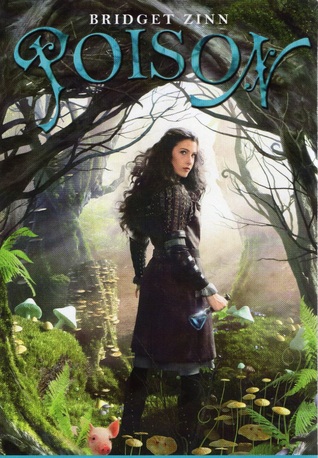
Pretty Poison


Mysterious Kyra is running from the law following a failed attempt on the life of her Kingdom's Princess Arianna.  Kyra is a master at potions, a lover of pie and a cunning assassin.  She is willing to risk her own life in order to complete her task, because she is certain that in order to save her Kingdom from destruction, the princess must die.  The princess who is also Kyra's very best friend.  

In this fast paced fantasy, the story unfolds delightfully.  Told from Kyra's point of view, we follow her through a quest which reveals an often humorous and relatable voice for young fantasy fans today.  After making a deal with a criminal, Kyra is stuck with Rosie, a pig with the ability to hunt down any person whose scent she is given.  Rosie leads Kyra to an incident where she is rescued by Fred, a mysterious young man and animal lover who is also traveling with his wolf like dog, Langley.  While it will be clear to readers that there is more to both Kyra and Fred than meets the eye not all of the revelations will be obvious and even the ones that may seem plausible will be satisfying when confirmed.  

Kyra's interaction with Fred as well as her friendship with Arianna both feel very genuine and Kyra's dedication to the field of potions and poisons makes her a different kind of heroine.  This is a highly readable novel, which will have a very wide appeal.  We can only hope we haven't seen the last of her.