Sunday, May 5, 2013

If you could only see the way she loves me, maybe you'd understand-


3.5 Stars  
A big thanks to NetGalley and Algonquin publishing house for the ARC version.

Now for the nitty gritty.
While I hoped that this would be a story of defiance in the name of true love, what I got was a more complacent look at the status of the gay community in Iran.  This does not mean that this was a bad story by any means.  In fact, I learned about the status of transsexuals in Iran which gave me a serious, "wrinkle in the brain" moment.

Let's get down to plot.  Sahar is a lesbian.  Living close by, her childhood friend Nasrin has also been her secret girlfriend for years.  Nasrin claimed Sahar as "hers" years ago when they were children and this bloomed into a deep love with the manic feelings of teenage lust and passion.  Nasrin, however is quick to declare to Sahar that they are not "gay" they are in "love" and while this may be the (pansexual) case for Nasrin, it is not for Sahar.  However, gay or not, what Nasrin says is true.  The two girls are indeed in love. 

There are some issues with their relationship, of course.  First, Sahar, while a valued friend of Nasrin's, is from a working class family while Nasrin is upper class.  More than that, the two girls live in Tehran, Iran, where a lesbian couple could be potentially killed.  Also, Nasrin seems more than a little selfish.  She is spoiled and has her whole family in tact, while Sahar has to care for her despondent father who has not been the same since the death of Sahar's mother.   While it is well known that Sahar is very smart and will most likely go to medical school, Nasrin is thought to be only good enough to marry rich.  And while Sahar dreams of herself being the successful doctor who will marry Nasrin, in reality Nasrin's family has arranged a marriage with a currently practicing (male) MD intern.  Blindsided by the engagement, Sahar is equally enraged and depressed.

The story takes a detour when Sahar's gay cousin, Ali introduces her to the gay underground in Tehran in hopes of showing Sahar that there are other eligible young women to fill the void that will be left by Nasrin.  What Sahar learns is that in Iran, a transsexual can receive a sex change operation at the partial expense of the government.  This is where that "wrinkle in the brain" came in for myself.  I looked it up and it is true.  "Gender reassignment" is considered a "cure" for a sickness in Iran.  If it is deemed that you actually are a man trapped in a woman's body or vice versa, not only is it sanctioned but the government will pay up to half the cost of the operation.  Iran is actually one of the countries with the highest number of gender reassignments preformed aside from Thailand.  However, as a homosexual, you are condemned.  

So, when Sahar meets a lovely woman named Praveen and discovers that she was once a he, love begins to take Sahar's mind to strange places.  If she was a man, she could marry Nasrin.  At least this is what Sahar believes, not taking into account how Nasrin's ultra showy family would feel about their daughter's childhood friend changing genders and marrying their princess.  Praveen agrees to introduce Sahar to a support group of transsexual youth but it becomes clear to everyone that Sahar is a lesbian and not trapped the the wrong body.  Sahar looks at the days ticking closer towards Nasrin's wedding and tries to speed up her "operation" in spite of herself.  It is a dreadful plan and everyone, including Sahar knows this.  However, it is all she has to get her through the day, especially when Nasrin frequently tells her that her heart belongs with Sahar.  

So that is the plot and background.  Without giving anything away, the story has a very open ending.  If you are expecting the girls to run away together or for the families to suddenly agree to call off the wedding and hide Sahar and Nasrin's love from the government, you will be sorely disappointed.  Again, this does not mean that this is a bad book.  I really feel that this is unfortunately a very real portrayal of how this situation could (safely) play out for these two.  Nasrin, we see is very used to creature comforts and would probably never give them up no matter how much she loves Sahar.  It also adds dimension to the story that Nasrin's fiance is actually a nice guy.  While it would have been easy for the author to create a monster akin to poor Maryam's husband in "A Thousand Splendid Suns", or so many other books that deal with arranged marriage, this author gives us a fine young man who is silly infatuated with Nasrin.  He is also eager to gain the approval of her best friend, Sahar.  Through no fault of his own, he is doomed to be hated.

Other great angles that adds some depth are the emerging friendship between Sahar and Praveen, Ali's rise and fall as the "go to guy" in the underground community and Sahar's love for her clinically depressed father.  Faced with many difficult choices, Sahar has more on her plate than other young lesbians in progressive countries and we want her to make the best ones, but because of her native country there are no easy answers.  This may make this read feel unsatisfying for some.  Still, that doesn't mean that it is not worth reading.  

Tuesday, April 16, 2013

Dreams and Shadows A review of an adult book

3 stars 

So, I picked up "Dreams and Shadows" after the book's marketing campaign finally wormed its way into my brain. Whenever I looked up a book I enjoyed or wanted to read, there was an ad for "Dreams and Shadows". 

As a children's librarian, the majority of what I read is, well, children's novels. This is not to say they are juvenile, most are quite sophisticated. Sometimes even more sophisticated than adult novels. And that is because children, tweens, teens, young adults, whatever you may call them are not stupid. I think it was Dr. Seuss who said ,"Children can smell a moral a mile a way." If that is not a direct quote, it is close. So while people get all high and mighty with me when I read children's books and say that it would drive them mad, because they are juvenile, I argue back that most of the time a good children's author will write a better story than an adult author. Because, while a child may not be totally jaded, they are not stupid. 

What does this have to do with "Dreams and Shadows"? I have been reading some adult literature lately for a number of reasons. One, I am running a 20-30 something book club at work and two, I feel like I need to be familiar with some of the more modern stuff. As I enjoy most of Neil Gaiman's writing, this one was suggested. And in a way I see how. Cargill weaves a dark fairy tale complete with some great research of fae and dark legends. Not all that "glitters" is gold in the world of fairies and djinn. Anyone who does a little probing of this type of lore realizes that cutesy victorian fairies are not very good representatives of the creatures of legend.

The main issue I had with this book was not the storytelling. I found that I wanted to know what happened next. There were points when I couldn't put it down. It was mainly the characters. 

I realize now, that I have gone through most of this review without talking about plot. Here, there are several plots running. The first is the doomed romance of Jared and Tiffany Thatcher, which begins as a story of a too perfect couple with all the luck. Their text book courtship is interrupted when they are chosen as targets of baby snatching fae who replace their newborn son, Ewan, with Knocks, a hideous changeling. This drives Tiffany to suicide and Jared to a watery death at the hands of other dark forces. Knocks is the only survivor, and while he proves a good villain, he is probably the only well fleshed out character in the entire novel. 

The second main plot is that of Colby Stevens, a little boy chosen by the cursed djinn Yashar to be "granted" a wish. When Colby's wish leads him into the dark realm of Austin Texas' fae Limestone Kingdom (yes, Austin Texas) he meets Ewan, grown into a boy around Colby's own age. While Ewan has grown into a precocious little boy seemingly beloved by the fae (especially Mallaigh or Molly, a young Sidhe) Knocks, Ewan's changeling counterpart seethes at Ewan's very existence. 

Everything comes together when ghosts or demons from the past come together and Colby discovers that Ewan's fostering by the fae has been part of a sinister plan. Colby, being a young boy who knows no better uses his bond with Yashar to give himself the power to save Ewan. Of course this is also not for the best.

The story follows these characters, Colby, Ewan, Knocks into their adult hood and while it was a fun ride, once again, only Knocks' rage fully fleshes out his character. I would have liked to get to know Colby and Ewan a bit better. Neither or them seem to display the power of emotions I like to see in protagonists. Once again, this is what children's novels do so very well. A good author will know that a child must connect with several characters on many levels. Therefore they will flesh them out. I would have liked more "flesh" on these bones. Yashar, the cursed djinn may have been the only other character that had enough substance to intrigue me.


Also, I know there have been several complaints about the female characters being very thin. While I agree, I can forgive some of them due to their fae nature. Still, I really like to see a well written female character that does not only exist as a love interest. Tiffany Thatcher and Knock's adopted mother Leila were as close as we could get to a well written heroine, but neither of them seemed to stick around long enough to be more than plot devices. However, neither of these plot devices were particularly bad, so I am not sure how much of a complaint that is. 

Littered between each chapter are "real" accounts of fairy activity from excerpts of a fake text written by a mysterious Phd. of metaphysical studies.

This is definitely worth a read. It is funny in places (especially when it comes to the dialogue between Yashar and the young Colby) and terrifying in others. However, there are parts of this novel that left me feeling like I had an itch I could never scratch. This was likely the holes in the characters.

Tuesday, April 9, 2013

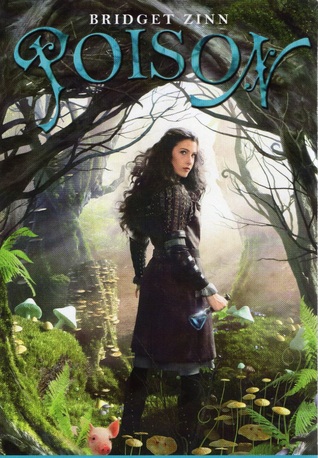
Pretty Poison


Mysterious Kyra is running from the law following a failed attempt on the life of her Kingdom's Princess Arianna.  Kyra is a master at potions, a lover of pie and a cunning assassin.  She is willing to risk her own life in order to complete her task, because she is certain that in order to save her Kingdom from destruction, the princess must die.  The princess who is also Kyra's very best friend.  

In this fast paced fantasy, the story unfolds delightfully.  Told from Kyra's point of view, we follow her through a quest which reveals an often humorous and relatable voice for young fantasy fans today.  After making a deal with a criminal, Kyra is stuck with Rosie, a pig with the ability to hunt down any person whose scent she is given.  Rosie leads Kyra to an incident where she is rescued by Fred, a mysterious young man and animal lover who is also traveling with his wolf like dog, Langley.  While it will be clear to readers that there is more to both Kyra and Fred than meets the eye not all of the revelations will be obvious and even the ones that may seem plausible will be satisfying when confirmed.  

Kyra's interaction with Fred as well as her friendship with Arianna both feel very genuine and Kyra's dedication to the field of potions and poisons makes her a different kind of heroine.  This is a highly readable novel, which will have a very wide appeal.  We can only hope we haven't seen the last of her. 

Monday, January 7, 2013

Cautionary Tales for Boys and Girls

4.5 Stars

Guillermo Del Toro once mentioned in an interview that darkness in children's films is necessary. Darkness addresses various neurosis and impulses that exist in the human condition and bypassing these truths does a disservice to children and how they deal with fear. Of course, I am paraphrasing big time, but that is the basic idea. Growing up in the 1980's and the early 1990's, my children's entertainment was far darker than it is today. For instance, I scoffed when people claimed that Pixar's "Brave" was too scary for children under the age of 12. Are they kidding? Do they know that when I was a child, I watched Atreyu brutally kill Gmork in the Neverending Story? I seem to remember some terrifying scenes in the film adaptions of "The Secret of Nymh" and "The Last Unicorn." I am not going to even begin to discuss most episodes of "Are you Afraid of the Dark." What does this all have to do with "The Cavendish Home for Boys and Girls"? This book is quite scary. It is also brilliant.

Basically, the story centers around Victoria, a perfect specimen of a child if she does say so herself. She is top of her class, loved by her teachers and always presentable. She doesn't have much need for friends, but she has found herself a project in classmate, Lawrence. Lawrence is an odd child with a streak of grey running through his unkempt hair. He is a musical prodigy, but always humming, a habit Victoria finds quite annoying. She has made it her goal to whip Lawrence into shape. This all comes to a head one strange day when some unraveling at school leads her to denounce Lawrence. Then he disappears. 

All of the adults, including Lawrence's parents claim that he has gone upstate, but there is something cruel in these proclamations and Victoria decides she will get to the bottom of it. A decision that leads her to the doorway of The Cavendish Home for Boys and Girls, a mysterious orphanage run by Miss Cavendish herself and her "project" Mr. Alice. Within this house leads Victoria on a terrible journey which is reminiscent of "Coraline" and slightly fable like in quality. 

In essence this is a very Victorian story. It is a cautionary tale. It is cautionary of cold Victorian values and has a heroine (albeit, a slightly annoying one) named Victoria. Miss Cavendish takes "difficult" children and strives to straighten them out. Some of her victims are Lawrence, who's odd humming and passion for music has begun of annoy his parents (children should be seen and not heard) and Jacqueline, the unkempt sister of Victoria's rival who's art work uses motifs of death and darkness. Then there is Victoria herself, who's crime may be her own perfection. If a child is straightened out by age 13 they are sent back to their home, but they are "changed" into a pale imitation of the person they once were.


Let it be known, there are some frightening elements of this book. It is very surreal and the implications of the horrors of the Cavendish home may not be suitable for younger or more sensitive readers. One example is the origin of the mysterious Cavendish casserole and her monstrous servants, the Gofers. I won't spoil it for anyone, but let's just say it is tied to fate of the children who do not make it to leave after their 13th birthday. Some of the scenes are also somewhat heartbreaking, but through Victoria's eyes we see something else. The caution against "too perfect". Miss Cavendish sees similarities between she and Victoria. Victoria too notices this and is horrified at the implications. 

The descriptive language is also quite beautiful, and while scary this book holds a lot of emotional value. Perhaps this is part of what Del Toro was talking about. In a world where competition to be "the best" and "elite" is pushed on some children from a very young age, this story strikes a chord.

Suffering for your art.

 A Solid 3 Stars
Oh, how I wanted to love this book! As a John Barrowman fan, I am well aware of how talented the man is. I really wanted that talent to carry over into his first children's novel. Not only was it getting good press, but he wrote it with his sister which is quite endearing.

I did not love this book. I liked a lot of it. I did not hate it. I also did not love it. The story is interesting enough. Twins Matt and Em discover that their ability to animate artwork that they create is due to their heritage as Animare. As mentioned in their abilities, Animare...animate their artwork. They are also naturally talented artists and many famous names in art history have been Animare. Van gough, for instance, was an Animare. However, these abilities come with a price. 

Sometimes Animare become power hungry or warped by their art. When this happens, a council of people called Guardians, who have powers meant to keep Animare in check bind the offender to one of their art works. When the story opens, Matt and Em are on the Guardian hit list. We discover that their mother, another Animare, broke a rule of the council by having children with a Guardian, giving the twins abilities of both. 

Furthermore, there is chatter of the return of a sinister group called, "The Hollow Earth Society", which believes that creatures created in the artwork of the Animare lives within the Earth wrapped up in another dimension. Anyway, Sandie, the mother of the twins spirits them away to an island in Scottland, where their Guardian Grandfather can protect them from those who wish to harm them. Mayhem ensues.

While there is some real inventive qualities of this story, the major problems I had with it were in pacing, language and characterization. Until the very end, the story seems to lag far more than it should. Part of this I attribute to my second problem with the book. Language. Most of the action reads like directions. We are told what the twins and their friends do and how they feel, but nothing in the language gives a sense of realism. The phrase, "show, don't tell" rang in my ears throughout a majority of the action.

Last, characterization. The twins, who are supposed to be nearly 13, behave as if they are a good three years young. I simply could not get a good sense of who they are through their words and actions. I barely bought their affection for their mother, grandfather or even for one another. I read the words, yes, but the emotion behind them felt flimsy.

Still, I would not write this off as a total loss. As mentioned, the premise is interesting enough. Also, the chapters are short, making this a good choice for fantasy fans intimidated by long winded prose. Hopefully the Barrowman siblings are simply cutting their teeth here and will follow up this work with a sequel worthy of their talent. Maybe that is just a fan's wishful thinking

Sunday, December 2, 2012

Avatar: The Last Airbender. Promises, promises.


4.5 stars
This is the conclusion to the first in what will probably be several graphic novels that bridge the end of Avatar: The Last Airbender to Avatar: The Legend of Korra.  While I enjoyed "Korra" for the most part I had some problems with the series in pacing and also some of the sloppy writing of new characters.  I was immensely pleased to see Aang and company captured so very well in Gene Leung's adaptation.

In the last two books (which I had not reviewed here) we found team Avatar in the midst of a few dilemmas.  First off, after the end of the war, Aang, the Earth King Kuei and now Fire Lord Zuko agreed to the Harmony Restoration project which would require the Fire Nation Colonies to evacuate "occupied territory".  The problem with this is that over a period of a century, the lines between the FIre Nation and Earth Nation have blurred in places where citizens have begun to intermarry.  For instance, Kori, a young earth bender identifies herself as Fire Nation.  Her father, a Fire Nation politician married a woman from the colony.

People like Kori and her family feel that it is unfair to move them since this is their ancestral home for over a century.  After Kori makes an assassination attempt on Zuko's life (during the first issue), Zuko realizes as Fire Lord he needs to consider the well being of his own citizens.  This puts him at odds with the treaty he has agreed to when the war ended.  He begins to make poor choices, the worst being consulting his father, the deposed Fire Lord Ozai, for advice.  For those who recall the animated series, Ozai was a tyrant who had taken his rage out on Zuko physically and emotionally in the past and conceals the fate of Ursa, the mother of Zuko and his sister Azula.  To complicate matters, Zuko had made Avatar Aang swear to kill him if Zuko himself began to exhibit Ozai like behavior.  Also, Mai, Zuko's consort leaves him when she discovers he has been keeping secrets from her.  This leaves the new Fire Lord very lonely and vulnerable at the start of this issue.

Further fleshed out in this issue are the very ideas behind what will ultimately found the Republic City, seen in the Legend of Korra series.  Katara, now comfortable in the role as Aang's girlfriend sees the mixed race culture emerging from the colonies (particularly Yu Dao, Kori's home) and foresees her own future as the wife of the last Air Nomad.  Aang is introduced and initially infuriated by a group of "fans" who wish to emulate the culture of his lost people.  These will eventually become the Air Acolytes.  This is really fascinating stuff as several of the characters refer to the world as "changing" from what existed prior to the great Fire Nation invasion which took place under Zuko's Great Grandfather Sozin.  This is very timely stuff in our own world where staunch ideals are flipping and bending to recognize the rights and needs of groups long ignored.

This is not to say that the series is without the signature humor that delighted audiences of the television series.  There is some real gold here.  The best being when characters recognize that Sneers, the portly and awkward former member of Jet's Freedom Fighter gang is dating the athletic and confident, Kori.  Everyone has the same reaction and while Sneers and Kori are confused by them, the audience should be delighted.  Aang and Katara's relationship feels least genuine when they refer to one another as "sweetie", a problem I have had in the past two issues.  In spite of this, you really see the emergence of a more mature romance between the two of them.  Aang appears to have grown taller and is a bit less childlike.  He and Katara discuss important issues and make mature choices in how to deal with them.  This is, of course all within a PG setting since this is based on a Nickelodeon series.  In fact, the only other problem I had with this series as a whole was the choice to swap out the word "kill" with "end" when referring to Aang's promise to Zuko.  I get that there were probably guidelines that Nickelodeon imposed in order keep this series within its original target audience, but it just felt inauthentic being that the book dealt with some really adult moral quandaries.

As a whole, this was fantastic.  As a series and more so as an issue.  Fans will be happy to see Sokka and Suki reunited and even Toph gets some lip service, even though she is not used to her fullest.  Furthermore we finally get to check in on Iroh at his tea shop, where he pays lip service to a current trend in sweet drinks, with a hilarious outcome.  I am very excited to see where this series takes us in the next arc, "The Search" which will deal with the long awaited answer on most fan's minds:  Where is Ursa?

Saturday, December 1, 2012

Not EXACTLY a love story.

Thanks to NetGalley for the ARC!


3 stars
One thing that has always bothered me about a majority of romantic comedy films is stalking.  I don't mean to be totally rude. The protagonist of this story is not a bad person.  He is actually pretty like-able.  Like-able for a stalker.  As much as I wanted to root for him, I just found his methods unsettling. It also kept me from loving this book.  Allow me to elaborate a bit.

Vinny (Vincenzo) Gold, a 15 year-old living in 1977, is surprised and disheartened to find out that his parents are getting a divorce. They assure him that they still care about one another (in fact it appears that dad is still in love with mom, adding insult to injury), but their relation has lost whatever spark brought them together.  Vinny's mom then marries his high school gym teacher, who is obsessed with football, as per the stereotype.  Vinny is not the football type.  Then, after a mugging in the subway, Vinny's mom and new stepdad decide to move to Long Island, where the stepfather has just accepted a job!

It is hard not to feel for Vinny.  He is pushed from one place or another due to things that affect him, yet are out of his control. We also discover that Vinny has "a girl" in his NYC school. Sadly for Vinny, she moved away. Sad for only Vinny, because this girl was unaware that she was "Vinny's".  He had been pining for her and done nothing about it.  So, pretty early on we know that Vinny is pretty shy, especially when it comes to girls.  In fact, we can assume that Vinny is just shy in general, because after arriving at this Long Island high school, he doesn't seem to be interested in making male friends.  He goes right from mourning the one sided relationship in his old school to lusting after his pretty female neighborm Patsy, in his new home.

After watching Patsy dress through his window to hers, Vinny becomes fixated on Patsy and begins a campaign of late night calls to her.  After eavesdropping on a conversation from a high school jock/classmate of his, Vinny gains access to Patsy's unlisted phone number.  His first few calls, which always seem to happen after midnight, are a disaster when Vinny makes an obscene comment to her.  Let me just explain, that I am not so much disturbed by Vinny's voyeur activities as I am by what happens with Patsy's phone number.  Vinny is a teenage boy and I am sure that a majority of teenagers his age would have succumbed to watching an attractive classmate dress if given the opportunity.  What bothered me was the relationship Vinny and Patsy forge through what is definitely phone stalking. 

Vinny feels badly about his racy comments to Patsy and continues to call trying to apologize.  On the same level though, he appears to be empowered by his status as "obscene caller".  He even uses this term to gleefully refer to himself several times.  I get that he is trying to be funny, but it came off as creepy.  Sure, Patsy calls him out on being creepy but plays this game with him hanging up whenever she feels the conversation has gone too far and continues to pick up every night when he calls back.  Since this is the late 70's Patsy can ask an operator if the call is local, but there are no other methods of discovering her caller's identity. 

Still, it is Vinny who has all the power in this relationship.  He only tells her that his name is "Italian" when she finally asks.  He begins to see himself as suave "Vincenzo" and acts like kind of a jerk to Patsy.  She knows he is a student in her school but that is it.  So basically she is being watched by someone who knows everything about her school social life (friends, boyfriends, etc) but does not know who it is.  For all she knows it could be a teacher?  She also at one point opens her heart to Vincenzo and asks for his number so she can call him back but he refuses.  We are expected to believe that this is due to Vinny's under confidence that he believes she would not want to date him if she "met" him, but really it keeps him in a position of power over her.  Again, creepy.

So when Vinny starts spending time with Patsy herself he struggles to merge his two personalities.  He clearly is not a bad guy, he defends Patsy's honor when the aforementioned jock disrespects her, but just does not say terribly kind things to her himself during their phone calls.  This is supposed to be romantic?  It really bothered me. 

Again, what kept me reading way that I did feel that Vinny was a good person.  Like I said, he is like-able, but the choices he makes just made my stomach churn.  The fact that he was empowered by these calls did not sit well with me.  I wish that we could have seen Vinny pursue regular friendships at school other than listening in on Patsy's friends conversations.  I appreciated the view of Vinny's ever changing relationship with his parents and their new lives.  I did enjoy reading his story, I just had too much trouble with what felt like the glorification of a habit that would become less charming as Vinny grew older.  Let us hope he learned his lesson.